Last Updated: November 1, 2026
Quick Summary
Most residential roof replacements take one to three days of crew time for an average-size home with asphalt shingles. The full project from signed contract to final cleanup usually runs two to four weeks once permits and material lead times are included. Larger, steeper, or more complicated roofs take longer.
- Crew time for an average asphalt roof is typically one to three days.
- Calendar time from contract to final walkthrough is usually two to four weeks.
- Permits and material lead times add to the schedule before crews arrive.
- Ask whether a quoted timeline means active work time or full project time.
- Weather delays and hidden decking damage are the most common causes of schedule slips.
Table of Contents
- How Long a Roof Replacement Takes on an Average Home
- Stage-by-Stage Schedule From Inspection to Cleanup
- Active Work Time vs. Total Calendar Time
- Can a Roof Be Replaced in One Day?
- Factors That Change the Timeline: Size, Pitch, Material, and Decking
- How Weather Delays and Seasonal Conditions Affect the Schedule
- Living in Your House During a Roof Replacement
- Booking Your Roof Replacement and Planning Your Schedule
- Frequently Asked Questions
How Long a Roof Replacement Takes on an Average Home
Most residential roof replacements take one to three days for an average-size home with asphalt shingles. That is the answer most homeowners want first, and it holds up across several roofing guides. The overall timeline can still vary, though, and a single number rarely fits every house.
One source reports that the average roof being replaced was slightly over 19 years old, according to RubyHome’s 2026 roofing statistics page. That figure describes the age of the roof at replacement, not how long the job lasts. Confusing the two is a common mistake when people research timing.
Your project will likely fall somewhere in that one-to-three-day window if your home is a typical size, the roof is a simple gable or hip design, and the material is standard asphalt shingle. Larger, steeper, or more complicated roofs take longer. A contractor can give you a realistic schedule once they see your roof.
Stage-by-Stage Schedule From Inspection to Cleanup
Below is a general stage-by-stage schedule for a typical asphalt shingle replacement on a 2,000-square-foot single-family home with a simple gable roof and sound decking. Treat the day counts as a planning baseline, not a promise.
Before work begins (calendar time, not crew time)
- Inspection and measurement (1-2 hours, usually 1-2 weeks before the install date). The contractor measures roof dimensions, counts penetrations (vents, chimneys, skylights), checks attic ventilation and decking from below where accessible, and photographs problem areas. This is also when you receive the written scope and material list.
- Permit application (1 day to submit; 3-10 business days for approval in most jurisdictions). Not every project needs a permit, but most full replacements do. The permit clock runs before the crew clock, so a slow permit office can push your install date without anyone touching your roof.
- Material order and delivery (2-7 days lead time). Shingles, underlayment, flashing, and ridge vent are typically dropped curbside or into the driveway one to two days before tear-off. Delivery placement matters, a 30-yard dumpster and a shingle pallet can consume most of a standard driveway.
Day 1: Tear-off and deck inspection
- Property protection (30-60 minutes). Crews lay tarps over landscaping, set the dumpster, and stage ladders and fall-protection anchors.
- Tear-off (3-6 hours for an average roof). Old shingles, underlayment, and nails come off in sections. This is the loudest, dustiest phase and the one most likely to run long if there are multiple layers of old roofing, a second layer can add several hours.
- Deck inspection and repair (1-3 hours, longer if damage is found). The crew walks the exposed deck, re-nails or replaces soft or delaminated sheathing, and addresses rotted fascia or flashing areas. Hidden damage discovered here is the single most common cause of a one-day slip.
- Dry-in (optional same day). If rain is forecast overnight, a responsible crew installs underlayment over the exposed deck before leaving. Ask whether your contractor does this, it is a good signal of professionalism.
Day 2: Installation
- Underlayment and flashing (2-3 hours). Synthetic or felt underlayment goes down, followed by drip edge, valley flashing, and step flashing at walls and chimneys.
- Shingle installation (4-6 hours). Field shingles go on from the eave up, followed by hip and ridge cap shingles. Steep pitches, dormers, and multiple valleys slow this phase noticeably.
- Ventilation details (1 hour). Ridge vent, soffit vent checks, and pipe boot flashing are finished here.
Day 3 (if needed): Completion and cleanup
- Punch-list items (1-2 hours). Final shingles, ridge cap, and any detail work the crew flagged.
- Cleanup and magnetic sweep (1-2 hours). Debris goes into the dumpster, tarps are folded, and the crew runs magnetic rollers over the yard, driveway, and walkways to pick up nails. Ask them to sweep a second time after the dumpster is removed, nails often surface then.
- Final walkthrough (30 minutes). The crew lead walks the roof and ground with you, photographs the finished work, and confirms the dumpster pickup date.
Ask your contractor for the schedule in writing before the job starts, including which day is tear-off and which is installation. Crews that can name their sequence in advance are usually the ones that hit it.
According to DLV Roofing’s 2026 replacement timeline guide, the active work usually fits within that short window, while the overall schedule depends on weather and preparation. The key distinction is that the day counts above describe crew time on your roof, the calendar time from signed contract to final walkthrough is usually two to four weeks once permits and material lead times are included.
Active Work Time vs. Total Calendar Time
Active work time is the hours crews spend on your roof. Total calendar time is how long the project takes from the first day to the last cleanup. These two numbers are often very different.
A crew might work eight hours a day for two days on the roof, but the project still spans a week because of permits, material delivery, and weather holds. When you hear “two days,” ask whether that means active work or the full project window.
Clear questions to ask your contractor:
- How many workdays are on the schedule?
- Does that include cleanup?
- What happens if it rains on day two?
Can a Roof Be Replaced in One Day?
Yes, some roofs can be replaced in a single day, but this is most realistic for smaller homes with simple designs. A crew of experienced roofers working a standard asphalt roof on a small house may finish within one long day.
Most homes take longer than that. Larger roofs, multiple roof planes, steep pitches, and damaged decking usually push the job into two or three days. Be wary of any promise of one-day completion for a complex roof, because that often means shortcuts or a rushed job.
Factors That Change the Timeline: Size, Pitch, Material, and Decking
Broad ranges are useful until you need to know whether your house is a two-day job or a five-day job. The table below converts the usual variables into planning estimates for common residential scenarios.
| Scenario | Typical crew workdays | What drives the number |
|---|---|---|
| Small home (under 1,500 sq ft), simple gable, asphalt shingle | 1-2 days | Small footprint, few penetrations, easy access |
| Average home (1,500-2,500 sq ft), gable or hip, asphalt shingle | 2-3 days | Standard complexity, one tear-off layer |
| Large home (2,500-4,000 sq ft), multiple roof planes, asphalt shingle | 3-5 days | More square footage, more valleys and flashing |
| Complex roof (dormers, skylights, steep pitch, multiple levels) | 4-7 days | Detail work and safety rigging slow every phase |
| Metal roof (standing seam or exposed fastener) | 3-6 days | Panel layout, fastening pattern, and trim work |
| Tile or slate roof | 5-10+ days | Heavy material handling, specialized labor, fragile product |
| Two-story or steep-access home | Add 1-2 days | Ladder and staging time, material hoisting |
| Second layer of old roofing to remove | Add 1 day | Double tear-off volume and disposal weight |
Size and square footage. Roofing is often measured by the “square”, 100 square feet of roof surface. More squares mean more material, more labor hours, and more disposal weight, and the increase is roughly linear until complexity starts compounding it.
Pitch and design complexity. A low-slope or walkable roof lets crews move quickly. A steep pitch (often defined as 8:12 or greater) requires harnesses, roof jacks, and slower movement.
Material. Asphalt shingles are the fastest common material because they are light, flexible, and familiar to nearly every crew. Metal panels require layout and fastening precision.
Decking condition. Decking repairs can add hours to a day, and extensive rot can add more. Discovering hidden damage mid-project is one of the most common surprises.
Building type. A single-family home with a simple footprint is the fastest scenario. Townhomes and rowhouses add party-wall flashing and shared-access constraints. Detached garages and additions with tie-in roofs add transition details. Commercial low-slope buildings use different systems entirely and follow a separate scheduling logic.
Use the table to set expectations, then ask your contractor to confirm which row your home falls into and why. A specific answer, “three days, because you have two valleys and a second layer”, is a better sign than a round number with no reasoning.
Simple roofs with sound decking move quickly. Complex roofs with damaged wood take longer. Ask your contractor how they handle decking problems and material transitions so you are not caught off guard when the schedule shifts.
How Weather Delays and Seasonal Conditions Affect the Schedule
Weather is the biggest source of unplanned delay. Rain, wind, snow, and extreme heat can all stop work. Crews will not install shingles on a wet deck, and high winds create safety risks.
Seasonal conditions matter too. Spring and early fall tend to offer steadier weather in New England, which is why many homeowners book then. Winter work is possible but often slower and more weather-dependent. Summer heat can make shingles harder to handle, and roofing crews often start early to beat the afternoon temperature.
Build a buffer into your plans. If you have a fixed date for something else, leave a few extra days so a rain delay does not cause a problem.
Living in Your House During a Roof Replacement
You can usually stay home during a roof replacement, but expect noise, foot traffic, and some disruption. Roofing crews use loud tools, and tear-off sounds like heavy rain on the roof above you.
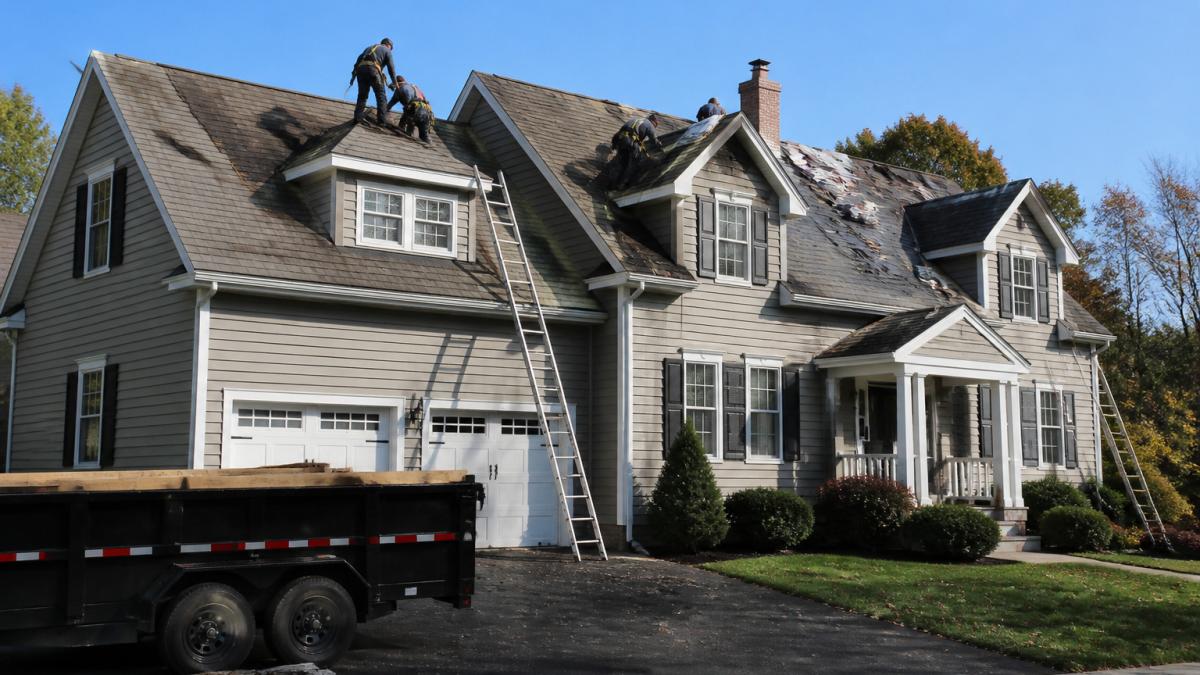
Helpful preparation steps:
- Move valuables and fragile items away from ceilings near the work area.
- Keep pets and children away from the yard where debris lands.
- Park vehicles away from the house and the dumpster.
- Plan to keep windows closed on work days, since dust can drift inside.
Ask your contractor where they will place the dumpster and magnetic sweeper so you know what to expect.
Booking Your Roof Replacement and Planning Your Schedule
Start by getting a detailed estimate that lists the project stages, expected workdays, and what happens if weather or hidden damage affects the timeline. For a clear step-by-step guide, read our [guide to getting a roof replacement quote | page:2], which explains what to compare before you commit.
When you are ready to move forward, [request a roof replacement from our team | page:1] and we will schedule an inspection and walk you through the timeline for your specific home.
Frequently Asked Questions
How long does an average roof replacement take?
Most residential roof replacements on an average-size home with asphalt shingles take one to three days of active work. The total calendar time can run longer because of scheduling, permits, and weather. Larger, steeper, or more complex roofs take more time, and crews may need extra hours or a day to repair damaged decking they find after the old shingles come off. Ask your contractor for a day-by-day estimate that separates work days from the project completion date.
Can a roof be replaced in one day?
A roof can be replaced in one day on a small, simple, single-story home with a low pitch and asphalt shingles, especially when the crew is large and the weather cooperates. Many average homes take one to three days instead. A day is rarely enough for complex rooflines, large homes, or jobs where damaged decking needs replacement. Your contractor can tell you whether one day is realistic for your specific roof.
What can delay a roof replacement?
Rain, high winds, snow, and temperatures too cold for shingles to seal are the most common causes of weather delays. Hidden damage to the roof decking found after tear-off can add hours or a day. Permit timing, material delivery, and contractor availability can also push the start date. Scheduling the project for a dry, stable season and confirming material delivery in advance reduces the risk of delays.
Ready to plan your roof replacement? Request a free estimate from All Weather Exteriors LLC, and we will give you a clear schedule, honest timing, and no surprises on the day the crew arrives.