Table of Contents
- Step 1: Verify Contractor Licensing and Credentials
- Step 2: Confirm Liability Insurance and Workers’ Compensation Coverage
- Step 3: Check Online Reviews and Ask for References
- Step 4: Questions to Ask a Roofing Contractor
- Step 5: How Many Roofing Estimates to Get and Compare
- How to Compare Roofing Estimates Line by Line
- Roofing Contractor Checklist Before You Sign
- Red Flags and What to Avoid
- Frequently Asked Questions
Last Updated: October 11, 2026
Step 1: Verify Contractor Licensing and Credentials
The first thing to check before hiring any roof replacement contractor is whether they hold a valid license in your state. A licensed contractor has met education and experience requirements set by your state’s licensing board.
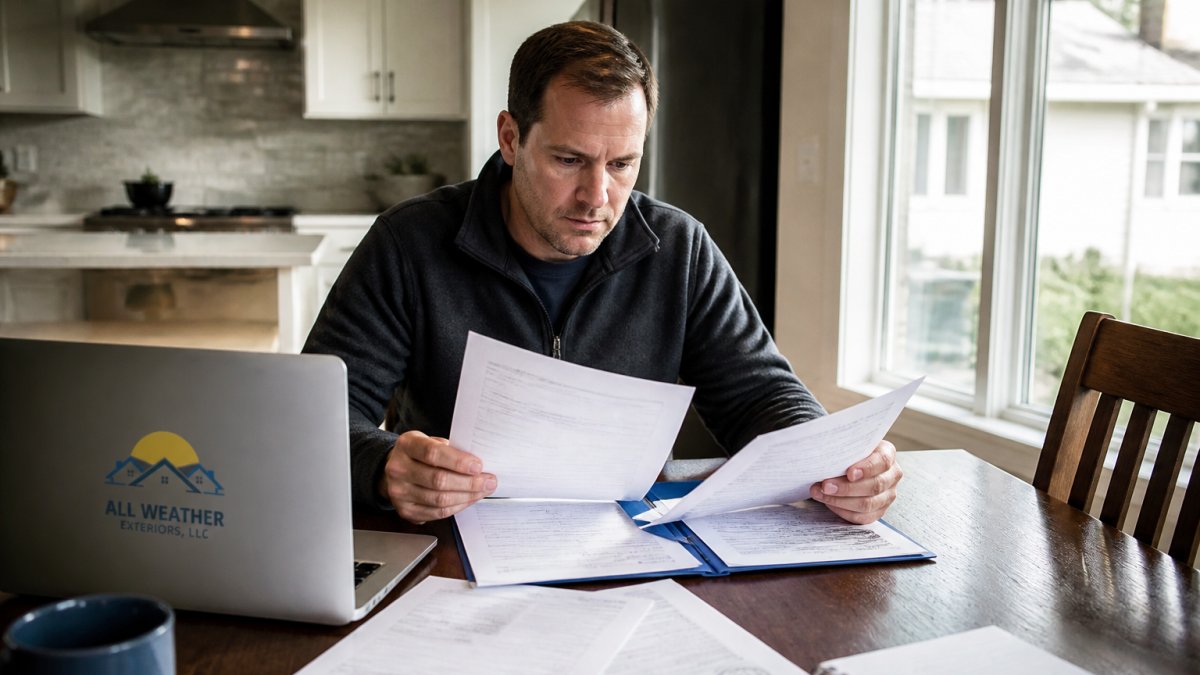
Ask the contractor for their license number. Then verify it directly with your state’s licensing board or department of consumer affairs. Do not rely on the contractor’s word alone.
Beyond licensing, check for certifications specific to roofing. Manufacturer certifications show the contractor has trained on installing specific roofing materials correctly. For example, some contractors earn certifications from shingle manufacturers or solar panel makers.
Ask about any additional qualifications:
- Membership in the National Roofing Contractors Association (NRCA)
- Certifications from roofing material manufacturers
- Apprenticeship training or journeyman status
- Continuing education in roofing codes and safety
At All Weather Exteriors LLC, we hold Master Elite® Certification, which demonstrates our commitment to quality installation and ongoing training. When you verify a contractor’s credentials, you’re confirming they take their work seriously and stay current with industry standards.
Step 2: Confirm Liability Insurance and Workers’ Compensation Coverage
Every professional roof replacement contractor must carry two types of insurance: general liability insurance and workers’ compensation coverage. These protect you if someone gets injured or property gets damaged during the work.
Liability insurance covers damage to your home or a neighbor’s property caused by the contractor’s work. Workers’ compensation covers medical costs if a worker gets hurt on your roof. Without this coverage, you could be liable for injuries or damage.
Never hire a contractor who claims they do not need insurance. Request proof of current insurance in writing. Ask the contractor to provide:
- A certificate of insurance showing general liability coverage
- A certificate showing workers’ compensation coverage
- The policy limits (at least $1 million in liability is standard)
- The policy expiration dates
- Confirmation that your address is listed as a certificate holder
Contact the insurance companies directly to verify the policies are active. Do not accept a verbal promise or a photocopy. Insurance fraud happens when contractors claim coverage they do not actually have.
Ask the contractor what happens if an accident occurs. A reputable roof replacement contractor will explain their claims process clearly. They should have a safety plan for the job site and require workers to follow safety protocols.
Step 3: Check Online Reviews and Ask for References
Online reviews give you insight into how the contractor treats customers and whether they complete projects on time. Check Google Reviews, the Better Business Bureau, and Yelp for feedback from past clients.
Read both positive and negative reviews carefully. A contractor with all five-star reviews might be new or have few customers. Look for patterns in reviews rather than single complaints. If multiple people mention the same problem, that is a red flag.
Pay special attention to reviews that mention:
- Whether the contractor finished on schedule
- Communication during the project
- Cleanup after work was done
- Warranty fulfillment
- How the contractor handled problems
Beyond online reviews, ask the contractor directly for references. Request the names and phone numbers of three to five customers from similar roofing projects completed in the last year or two. Contact these references and ask:
- Did the contractor show up on time and finish when promised?
- Did the contractor communicate clearly throughout the project?
- Were there any issues, and how did the contractor handle them?
- Would you hire them again?
- How is the roof holding up?
A strong roof replacement contractor will have happy customers willing to speak about their experience. If the contractor hesitates to provide references, that suggests they may have unhappy customers.
Step 4: Questions to Ask a Roofing Contractor
Before you hire a roof replacement contractor, ask specific questions about how they work. These questions reveal whether the contractor is organized, experienced, and professional.
Ask about their experience with your roof type and home age. A contractor experienced with older homes understands different structural challenges than someone who only works on new construction.
Discuss the project timeline. Ask:
- When can you start?
- How many days will the roof replacement take?
- What happens if weather delays the work?
- Will the crew work on weekends or evenings?
- What cleanup happens each day?
Ask about the roofing materials they recommend and why. A good contractor explains material choices based on your climate, home style, and budget. They should discuss durability, warranty coverage, and maintenance needs.
Clarify the payment schedule before signing a contract. Ask:
- What is the total cost?
- When are payments due?
- Do you require a deposit, and how much?
- What happens if the project costs more than the estimate?
Ask about warranties. A roof replacement contractor should offer two types: a workmanship warranty covering their installation labor and a manufacturer warranty covering the roofing materials. Understand what each warranty covers and how long it lasts.
Finally, ask how the contractor handles problems. What if something goes wrong after the work is done? How do you contact them? This matters because you want to know they will stand behind their work.
Step 5: How Many Roofing Estimates to Get and Compare
Getting multiple estimates is essential when choosing a roof replacement contractor. One estimate is not enough. Most homeowners should get three to five estimates before deciding.
Multiple estimates serve two purposes. First, they help you understand the typical cost range for your project. Second, they let you compare how different contractors approach the work and what they charge.
When requesting estimates, provide the same information to each contractor. Tell them your roof’s age, size, and current condition. Mention any specific concerns like leaks or damage. This ensures you get comparable quotes.
Schedule estimates at different times so you can ask questions and observe how the contractor behaves. A professional roof replacement contractor will spend time examining your roof, ask about your needs, and explain their recommendations.
As you collect estimates, keep track of:
- The contractor’s name and license number
- The estimated cost and what it includes
- The timeline for the project
- Warranty details
- Payment terms
- Any concerns or red flags
Do not automatically choose the lowest estimate. The cheapest contractor may use lower-quality materials, rush the work, or have less experience.
How to Compare Roofing Estimates Line by Line
When you have multiple roofing estimates, comparing them properly takes time but saves money and headaches. Look beyond the total price. Examine what each contractor is actually proposing.
Create a simple chart with columns for each contractor. List these items:
| Item | Contractor A | Contractor B | Contractor C |
|---|---|---|---|
| Roofing material type | Asphalt shingles | Architectural shingles | Metal |
| Material grade/quality | Standard | Premium | Premium |
| Labor cost | $X | $X | $X |
| Material cost | $X | $X | $X |
| Removal of old roof | Included | Extra charge | Included |
| Underlayment type | Standard | Synthetic | Synthetic |
| Warranty (workmanship) | 10 years | 20 years | Lifetime |
| Warranty (materials) | 20 years | 30 years | 50 years |
| Timeline | 3-4 days | 5-6 days | 4-5 days |
| Payment schedule | 50% down, 50% at completion | 33% down, 33% mid, 33% completion | 25% down, balance at completion |
Compare the material quality first. Two estimates may differ because one contractor uses premium shingles while another uses standard shingles. These are not the same product, so the prices should differ.
Check what is included in the estimate. Some contractors include roof removal, disposal, and underlayment replacement. Others charge these as extras. An estimate that looks cheap may not include everything you need.
Look at the warranty details carefully. A longer workmanship warranty shows the contractor is confident in their work. A longer material warranty reflects the quality of the shingles or other roofing materials.
Pay attention to the payment schedule. Avoid contractors who demand large upfront payments. A typical schedule is 25-50% deposit, with the balance due upon completion. If a contractor wants 100% payment before starting, that is a warning sign.
Roofing Contractor Checklist Before You Sign
Before you sign a contract with a roof replacement contractor, verify everything one final time. This checklist ensures you have covered all the important details.
Use this checklist as you prepare to hire:
- Contractor holds a valid, current license in your state
- General liability insurance verified with the insurance company
- Workers’ compensation insurance verified with the insurance company
- Certificate of insurance lists your address as a certificate holder
- References contacted and confirmed positive feedback
- Online reviews checked for patterns of complaints
- Experience with your roof type and home age confirmed
- Roofing materials specified in the estimate
- Material quality and grade clearly stated
- Labor and material costs listed separately
- Removal and disposal of old roof included or priced separately
- Underlayment type and quality specified
- Workmanship warranty detailed in writing
- Manufacturer warranty details provided
- Project timeline and start date confirmed
- Payment schedule agreed upon in writing
- Cleanup plan discussed
- Process for handling changes or problems explained
- Contract reviewed and all terms understood
- No high-pressure sales tactics or rush to sign
Before signing, read the entire contract word by word. Do not sign anything you do not fully understand. Ask the contractor to explain any terms that seem unclear.
Confirm that the contract includes the project scope, materials, cost, timeline, warranty, and payment terms. The contract should also describe what happens if the project costs more than estimated or takes longer than planned.
Red Flags and What to Avoid
Certain behaviors and practices signal that a contractor may not be trustworthy. Learning these red flags helps you avoid bad experiences and poor-quality work.
Avoid contractors who:
- Pressure you to decide immediately or offer discounts that expire today
- Ask for large cash payments or payment in full before work starts
- Do not have a valid license or refuse to provide proof of insurance
- Cannot provide references or have negative online reviews
- Use high-pressure sales tactics or become defensive when questioned
- Quote a price that is far lower than other estimates without clear explanation
- Do not provide a written estimate or contract
- Guarantee they can fix problems without inspecting your roof first
- Offer to handle insurance claims or promise to get your insurance to pay
- Lack a permanent office or business address
- Arrive in unmarked vehicles or do not wear company uniforms
Storm chasers are contractors who travel to areas after severe weather and offer quick roof replacements. They often use high-pressure tactics and disappear after taking payment. Avoid any contractor who approaches you unsolicited after a storm.
Be cautious of contractors who promise to handle your insurance claim. While some legitimate contractors help with paperwork, others use this as a way to overcharge and commit insurance fraud.
If a contractor seems evasive about pricing, warranty details, or their experience, trust your instinct. A reputable roof replacement contractor is transparent and patient with your questions.
Choosing the right roof replacement contractor protects your home and your wallet. At All Weather Exteriors LLC, we understand how important this decision is, which is why we prioritize transparency, quality workmanship, and customer communication from the first estimate through project completion.
Frequently Asked Questions
How do I verify a roofing contractor’s license and insurance?
Contact your state’s licensing board or construction board to confirm the contractor holds a valid license. Ask the contractor directly for proof of liability insurance and workers’ compensation coverage, and request they provide documentation you can verify independently with their insurance carrier. A reputable roof replacement contractor will have no problem supplying this information immediately.
How many roofing estimates should I get before hiring a contractor?
Get at least three estimates from different contractors. This allows you to compare pricing, materials, project scope, and timelines. Three estimates is the industry standard for making an informed decision without creating unnecessary delays. Each estimate should be detailed and in writing so you can compare them accurately.
What should a roof replacement estimate include?
A complete estimate should list roofing materials by brand and grade, labor costs, removal and disposal fees, permits and inspections, warranty details (both workmanship and manufacturer), project timeline, payment schedule, and cleanup procedures. If an estimate is vague or missing key details, ask the contractor to provide a line-by-line breakdown before you proceed.
What are red flags when hiring a roofing contractor?
Avoid contractors who pressure you into immediate decisions, demand full payment upfront, lack verifiable references, cannot provide proof of insurance, or offer prices significantly lower than other bids. Also be wary of door-to-door solicitation after storms, contractors who won’t provide written contracts, and those unwilling to answer your questions thoroughly.