Table of Contents
- Why Contractor Insurance Verification Matters
- Step 1: Request a Certificate of Insurance
- Understanding the ACORD 25 Certificate
- Contractor Certificate of Insurance Checklist
- Questions to Ask About Contractor Insurance
- “What are your general liability limits, per occurrence and aggregate?”
- “Does your policy exclude any part of the work you’ll be doing?”
- “What endorsements are on the policy?”
- “Who are your subcontractors, and can I see their certificates too?”
- “Do you carry a surety bond, and what does it cover?”
- “How long have you been continuously insured, and with which carriers?”
- “What happens if someone is injured on my property?”
- Red Flags When Hiring a Contractor
- Verify Insurance Directly With the Carrier
- Check Contractor Licensing and Business Details
- Frequently Asked Questions
Last Updated: October 16, 2026
Why Contractor Insurance Verification Matters
Hiring a contractor without the ability to verify contractor insurance exposes you to liability.
A contractor without active coverage can leave you responsible for medical bills, property damage, or legal fees.
Verification also protects the contractor: licensed, insured professionals expect to show proof. If a contractor refuses or gets defensive, that’s a red flag.
Request proof of insurance BEFORE the contractor starts work, not after. Once work begins, it’s too late to back out if coverage is missing or expired.
Step 1: Request a Certificate of Insurance
The first step to verify contractor insurance is simple: ask for it.
Be specific: “Please send me a current certificate of insurance showing general liability and workers’ compensation coverage.” Give them 48 hours.
A legitimate contractor complies without hesitation. If they push back, delay, or offer excuses, move on.
Save the certificate in PDF format, you’ll need it to verify the details in the next steps.
If a contractor says “I’ll get you that after we sign the contract” or “We’ll handle it before work starts,” walk away. Insurance must be in place before any work begins, not after.
Understanding the ACORD 25 Certificate
The ACORD 25 certificate is the standard U.S. form for documenting contractor insurance. ACORD stands for Association for Cooperative Operations Research and Development.
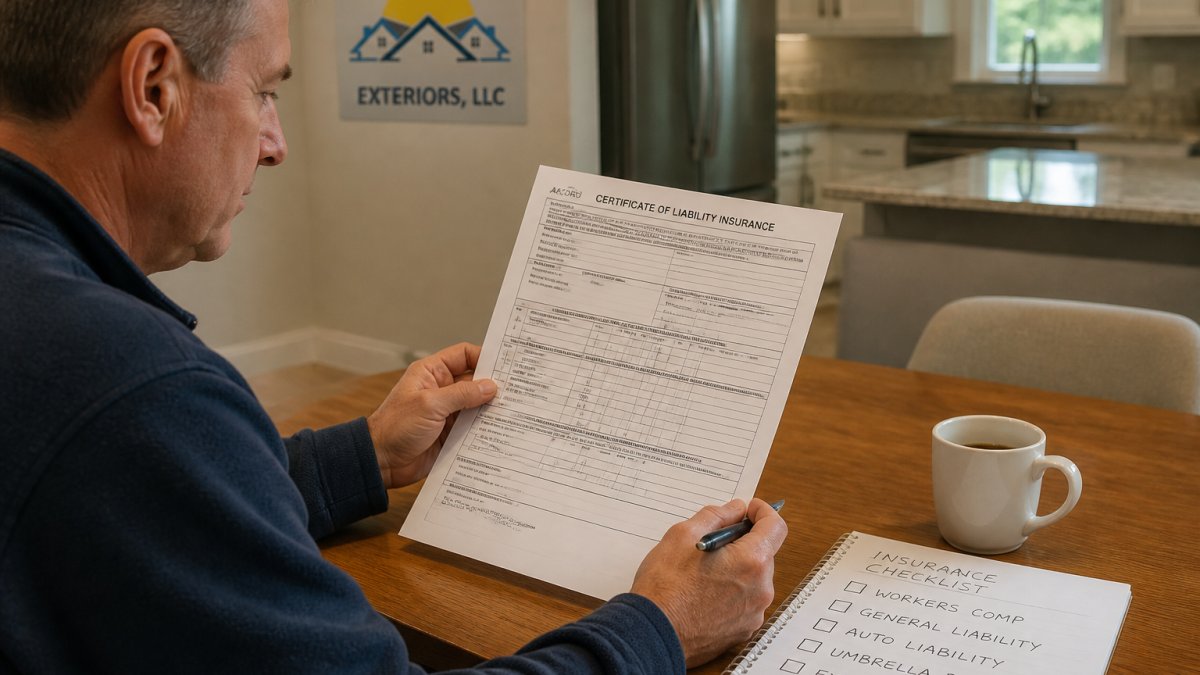
The ACORD 25 shows the contractor’s name, insurance company, policy numbers, coverage types, limits, and policy dates.
Some contractors use their insurer’s custom form instead. That’s acceptable if it shows the same core information: policyholder name, carrier, policy dates, coverage types, and limits.
Key fields to review on the ACORD 25
Check these fields:
Policyholder name: Must match the contractor’s legal business name, or the certificate may not belong to them.
Insurance carrier: Look for a recognizable name licensed in your state.
Policy numbers: General liability and workers’ compensation should each have a separate policy number.
Coverage dates: The “effective date” is when coverage starts; the “expiration date” is when it ends.
Coverage limits: How much the insurance will pay. General liability limits often read as “X/Y/Z” (e.g., “$1M/$2M/$2M”).
Contractor Certificate of Insurance Checklist
Go through this checklist before allowing work to start.
- Certificate is current (expiration date is in the future)
- Contractor’s legal business name matches the certificate
- General liability coverage is listed with a policy number
Coverage types to verify
General liability insurance protects you if the contractor damages your property or injures a third party.
Workers’ compensation insurance covers the contractor’s employees if they’re hurt on the job.
Property insurance is less common but covers tools and materials the contractor brings to your property.
Ask: “What coverage types do you carry?” Compare their answer to the certificate and clarify any mismatch.
Policy dates and status confirmation
If the expiration date is within 30 days, ask when the policy renews, you want coverage through your entire project.
Check the effective date too: new policies sometimes have waiting periods.
If the expiration date has passed, the policy is expired. Do not hire this contractor, expired insurance means zero protection.
An expired or expiring policy is a deal-breaker. The contractor may be between insurance providers or may have let coverage lapse. Either way, it’s not your risk to take.
Questions to Ask About Contractor Insurance
A certificate tells you what coverage exists, not whether it’s enough for your project, or whether an exclusion removes the risk you’re worried about. These questions close that gap.
“What are your general liability limits, per occurrence and aggregate?”
General liability limits are usually three numbers, e.g. $1,000,000 / $2,000,000 / $2,000,000:
- Per occurrence, the most the policy pays for any single accident or claim.
- General aggregate, the most it pays for all claims during the policy period combined.
- Products-completed operations aggregate, the most it pays for claims from work the contractor has already finished (this covers you after the crew leaves).
A common baseline for residential work is $1,000,000 per occurrence and $2,000,000 aggregate, but the right number depends on your project:
- Property value. Match the per-occurrence limit to at least the replacement value of the structure being worked on.
- Injury exposure. Work at height, roofing, tree removal, and excavation carry higher bodily-injury risk, justifying higher limits.
- Aggregate vs. your project. A contractor running multiple jobs can exhaust the aggregate on other projects. Ask how much remains available.
If the contractor can’t state their limits from memory, that’s not automatically disqualifying, but they should produce the certificate or call their agent within a day.
“Does your policy exclude any part of the work you’ll be doing?”
This separates real verification from a checkbox. General liability policies contain exclusions that directly affect construction and exterior work:
- Roofing and work at height, some policies exclude or sublimit roofing, or require a separate endorsement.
- Residential vs. commercial, a commercial policy may exclude residential projects, and vice versa.
- Mold, asbestos, and pollution, commonly excluded, which matters for remediation and older-home work.
Ask the contractor to point to the exclusions section, or ask the agent during your carrier call. If your work is excluded, the certificate is technically accurate and practically useless.
“What endorsements are on the policy?”
Endorsements amend coverage. Two matter most to homeowners:
- Additional insured endorsement. Adds you to the contractor’s policy for claims arising from their work, stronger than being listed as certificate holder. Ask the contractor to request it from their agent; often free or cheap, and takes a day or two.
- Waiver of subrogation. Prevents the contractor’s insurer from paying a claim then suing you to recover it. Common in commercial contracts; worth requesting on larger residential projects.
A certificate holder listing is not additional insured status, the certificate usually says so in small print. If it matters, get written confirmation from the agent that the endorsement was issued.
“Who are your subcontractors, and can I see their certificates too?”
This is the most commonly missed gap. A prime contractor’s policy generally does not cover the independent subcontractors they bring on site.
Ask the prime contractor:
- Will any part of this job be subcontracted? Which parts?
- Will each subcontractor carry their own general liability and workers’ compensation?
- Can you receive a certificate for every subcontractor before they start work?
Run the same verification on each subcontractor’s certificate. If the prime says their policy covers all subs, get the agent to confirm in writing, many policies exclude subcontracted work unless conditions are met.
“Do you carry a surety bond, and what does it cover?”
A surety bond is not insurance, it’s a three-party guarantee that the contractor will perform the work and pay certain obligations. A performance bond backs job completion; a payment bond backs payment of subs and suppliers, protecting you from mechanic’s liens. Not every residential contractor carries bonds, but for large projects they’re worth requesting, and a contractor who can obtain one has been vetted by the bonding company.
“How long have you been continuously insured, and with which carriers?”
A contractor with years of continuous coverage across one or two carriers is lower risk than one who bounced between carriers or had gaps, gaps sometimes indicate claims, cancellations for non-payment, or a carrier declining to renew. You don’t need a full loss run for a typical residential job, but a straightforward answer is a good sign.
“What happens if someone is injured on my property?”
Their workers’ compensation should cover injuries to their employees; their general liability should cover injuries to third parties. If the contractor says you’d be responsible, or that their insurance “doesn’t cover that,” treat it as a red flag and confirm with the carrier before proceeding. Maintaining this level of scrutiny remains equally critical when you verify home watch insurance to ensure that every service provider entering your property carries adequate protection.
The certificate answers “do they have insurance?” These questions answer the more important one: “does that insurance actually protect me on this project?” Ask all of them, and get the answers confirmed by the agent or carrier, not just by the contractor.
Red Flags When Hiring a Contractor
Some warning signs mean you should keep looking. Trust your instincts.
No insurance or refuses to provide proof. Automatic disqualification, no exceptions.
They get defensive when you ask for insurance. Professionals expect the question.
They pressure you to sign before showing insurance. Legitimate contractors provide proof upfront.
References don’t check out or they have none. Ask for three recent customers.
Verify Insurance Directly With the Carrier
A certificate of insurance is a snapshot, not a guarantee. It’s issued by an agent or broker, can be altered, and doesn’t update when a policy is cancelled mid-term. The only way to know a policy is in force on the day work starts is to confirm it with the carrier or agent, using contact information you found yourself, not what the contractor handed you.
Get the agent’s contact details independently
This is the step almost everyone skips. The number on a contractor-supplied certificate may be one the contractor controls. Instead:
- Pull the carrier’s name off the certificate.
- Search the carrier’s official website for its claims or customer service line, and use that number, not the one on the PDF.
- Ask the carrier for the agent of record, the licensed producer who sold and services the policy.
- Call the agency directly using a number you looked up, and ask for the producer or their assistant.
If the certificate lists a producer or agency, cross-check that it exists and is licensed. Most state departments of insurance publish a free producer/agency lookup; an agency that doesn’t appear there is a serious red flag.
What to ask, a script you can read
Keep it short and specific, carriers and agents confirm basic policy facts every day.
“Hi, I’m a homeowner preparing to hire [contractor legal name]. I have a certificate of insurance showing policy number [number] with an effective date of [date]. Can you confirm three things for me: (1) is this policy active today, (2) what are the general liability per-occurrence and aggregate limits, and (3) is workers’ compensation coverage included or is the contractor exempt?”
Then ask the follow-ups that matter:
- “Has this policy been cancelled, non-renewed, or is it in a grace period for non-payment?” A policy can be active today and cancelled next week.
- “What is the policy term, the actual start and end dates?” Confirm these match the certificate.
- “Is the named insured exactly [contractor legal name]?” A policy written to a different entity (a spouse, a defunct LLC, a similar-sounding company) doesn’t protect you.
Document the confirmation
Create a one-page record and keep it with your contract:
- Date and time of the call
- Representative’s name and the carrier or agency
- The phone number you dialed and where you found it
If the carrier will only verify in writing, submit the request in writing and keep a copy. If they won’t confirm anything to a third party, ask the agent of record to issue a new certificate naming you as certificate holder, a normal request that comes from the insured.
If the carrier has no record of the policy number, says the named insured is a different entity, or reports the policy was cancelled, stop. Do not accept a replacement certificate from the contractor without running this same check on the new policy number. Altered and forged certificates are uncommon but real, and the direct-carrier call is the only step that reliably catches them.
Red flags specific to this step
- The contractor asks you not to call the carrier, or says the agent is “hard to reach.”
- The producer or agency doesn’t appear in your state’s insurance producer lookup.
- The carrier’s phone number routes to a generic answering service that can’t confirm policy details.
A five-minute call to a number you found yourself is the highest-value step in this process, it converts a piece of paper into verified fact.
Check Contractor Licensing and Business Details
Insurance verification is only part of vetting.
Check your state’s contractor licensing board. Most states require licensing for roofing, electrical, plumbing, and HVAC work.
Confirm:
- License is active (not suspended or revoked)
- License covers your type of work
- License hasn’t expired
Search the Better Business Bureau for complaints, recent ones about insurance or licensing are worth investigating.
Ask for their business license and contractor license numbers. Legitimate contractors have both and provide them instantly.
Verifying contractor insurance protects your home and wallet. All Weather Exteriors LLC is ready to provide full proof of insurance and can start your exterior renovation with confidence. Request a Free Estimate today.
Frequently Asked Questions
How do I verify a contractor’s insurance policy number?
Ask the contractor for their certificate of insurance (COI), which displays the policy number in the upper left corner. Contact the insurance carrier directly using the phone number on the certificate, do not use a number the contractor provides. Confirm the policy number, policyholder name, and that coverage is active. Many insurance carriers offer online verification tools on their websites where you can enter the policy number to check status.
What should I check on a contractor’s certificate of insurance?
Review the contractor’s name and business details, policy effective and expiration dates, coverage types (general liability and workers’ compensation), coverage limits, and the certificate holder (your name or project name should be listed). Verify that the certificate shows the current date and that all coverage is active. Check for any exclusions or endorsements that might affect your project. Confirm the insurance agent and carrier contact information.
Should I contact the insurance company to verify a contractor’s coverage?
Yes. Directly contacting the insurance carrier is the most reliable way to verify coverage. Call the phone number listed on the certificate of insurance to confirm the policy is active, the coverage limits are adequate, and there are no pending cancellations. This step prevents fraud and confirms the contractor has not provided an expired or altered certificate. Never use contact information the contractor supplies, always verify it independently through the carrier’s website.
What are red flags when checking a contractor’s insurance?
Watch for expired policy dates, missing coverage types (general liability or workers’ compensation), unusually low coverage limits, illegible or altered certificates, gaps between policy periods, missing contractor or business name details, or a certificate holder name that doesn’t match your project. If the contractor refuses to provide proof, cannot name their insurance carrier, or becomes defensive when asked, these are serious warning signs. Avoid contractors without active, verifiable insurance.