Last Updated: November 7, 2026
Quick Summary
Solar shingles suit New England homeowners who want a low-profile look and are already planning a roof replacement, since they replace roofing material and install directly onto the roof deck. Choose them only after confirming the roof is in good condition, unshaded, and structurally sound, and compare total costs against traditional panels.
- Solar shingles replace roofing material, so they fit best when a roof replacement is already due.
- Traditional on-roof panels are generally the more efficient option for coastal New England homes.
- Ask each installer for a quote that separates roofing costs from solar costs.
- Size the system on annual output, since winter production is lower and snow can cut output further.
- Ice-and-water shield and attic ventilation matter more than the shingles for preventing ice dams.
Table of Contents
- Why New England Homeowners Are Looking at Solar Shingles
- Solar Shingle Cost: What You Pay Up Front and Over Time
- Solar Shingles vs. Solar Panels: Which Fits Your Roof
- GAF Solar Shingles and Other Product Options
- Solar Shingles in Snow and Cold Weather
- Roof Suitability Checklist for New England Homes
- Booking Your Roof Assessment and Free Estimate
- Frequently Asked Questions
Why New England Homeowners Are Looking at Solar Shingles
Solar shingles are roof-integrated solar cells that look like ordinary roofing, and Homeowners who want to cut their heating and electric bills are asking about solar shingles for new england roofs more often, largely because the appearance is the main draw. A California Polytechnic State University study on solar shingle value reports that homeowners generally find solar shingles more aesthetically pleasing than traditional solar panels, and that aesthetic appeal has helped draw attention to the technology.
Solar roofing is a broader category that includes shingle systems, so the term covers more than one product type. Shingles install directly onto the roof deck, which means they replace part of the roof covering rather than sitting on top of it. Learn more about solar roofing solutions and what the installation involves for your roof.
For New England homeowners, the decision usually comes down to three questions: how the roof looks, how much power it produces, and how it holds up in cold, snow, and coastal wind. The sections below take each question in turn. If you are weighing a roof replacement at the same time, All Weather Exteriors LLC’s roofing and solar solutions can be reviewed together so you see the full project cost.
Solar Shingle Cost: What You Pay Up Front and Over Time
Most solar-shingle articles either quote a single national average or dodge the number entirely. Neither helps a homeowner deciding between a shingle roof, a rack-mounted array, and a plain roof replacement. The useful approach is to break the project into the cost buckets that actually move the total, then run the same assumptions across all three options so you can see where the money goes.
The four cost buckets
Every solar-shingle quote should separate these line items, and you should ask for them separately in writing:
- Roofing labor and tear-off. Removing the old covering, inspecting and repairing decking, and installing underlayment. This is work you would pay for on any roof replacement, solar or not.
- Solar shingles and balance of system. The shingles themselves plus wiring, junction boxes, rapid shutdown equipment, and the inverter or microinverters.
- Electrical and interconnection. Panel upgrades, meter work, utility application fees, and inspection.
- Permitting and soft costs. Building permits, structural review if needed, and any HOA or historic-district approvals.
The reason to separate them: only the solar portion is eligible for the federal residential clean energy credit, and only the roofing portion is comparable to a standard roof replacement bid. Blended quotes hide both facts.
Why we do not publish a standard price
Installed cost per watt for solar shingles varies too widely across the region to quote responsibly, roof complexity, the number of small roof planes, snow-guard and ice-dam detailing, and utility interconnection rules all shift the number. A Future Market Insights global solar-shingles market forecast projects the broader solar-shingle market at USD 394.2 million in 2026, but that is a market size, not a homeowner price. Treat any article that gives you one flat number for the whole region with suspicion.
A side-by-side scenario framework
Instead of a single price, run your own comparison using the same inputs for each option. One practical way to compare options is to model three cases on the same roof:
- Solar shingles only, full tear-off, new solar roof, one project.
- Roof replacement plus rack-mounted panels, new asphalt shingle roof, then a separate panel array on top.
- Rack-mounted panels on the existing roof, only viable if the roof has enough service life left to outlast the array.
For each case, capture the same five inputs: system size in kilowatts, your utility’s residential rate per kilowatt-hour, the estimated first-year production in kilowatt-hours, the incentive dollars you actually qualify for, and the financing terms. Then compute simple payback as net cost after incentives divided by first-year electricity savings. If you finance, compare the monthly loan payment to the monthly bill offset, that is the number most homeowners actually feel.
Incentives that change the math
The federal residential clean energy credit covers a percentage of qualifying solar costs, and battery storage installed with the system can qualify too. State and utility programs differ sharply across the region, some states have robust net-metering rules, others have moved to lower export compensation, and rebate availability changes annually. Confirm current program terms with your utility and your state energy office before you sign, because an incentive that expired last year will wreck a payback estimate built on it.
What to ask for in a quote
Ask each installer for a line-item quote that separates roofing from solar, states the assumed production and utility rate, lists the incentives applied, and shows the payback both with and without financing. For a sense of how roofing and siding projects are typically priced in this market, see our Roofing and Siding Contractor Pricing Guide for 2026.
Watch out: a quote that folds the roof replacement and the solar system into one number without a breakdown makes it impossible to tell whether you are overpaying for the roof or the solar, insist on the split before you compare bids.
Solar Shingles vs. Solar Panels: Which Fits Your Roof
Solar shingles and conventional panels produce power in different ways, and the right choice depends on the roof. Panels mount on top of an existing roof and are typically the more efficient option.
Shingles have a different advantage. Because heat management depends on the roof assembly as well as the shingles, comparing roofing materials with Covenant Roofing & Restoration can help clarify which options suit the home.
A practical rule: if your roof is near the end of its life, a shingle system may make sense because you pay for the roof anyway.
The two systems differ in efficiency, roof fit, and when each makes sense.
| Option | Best for | Key difference |
|---|---|---|
| Traditional on-roof panels | Coastal New England homes | Generally the more efficient option |
| Solar shingles | Homeowners planning a roof replacement | Replace roofing material; low-profile look |
| Shingles near end of roof life | Roofs due for replacement anyway | You pay for the roof regardless |
| Panels on a young, sound roof | Roofs in good condition | Simpler path than a full shingle roof |
GAF Solar Shingles and Other Product Options
GAF Energy sells the Timberline Solar ES 2 shingle, which installs directly onto the roof alongside GAF Timberline shingles to form a solar-power roof system, according to GAF Energy product information. Other manufacturers offer their own solar shingle and solar roof tile products, so a GAF system is one option among several.
When comparing products, look at the warranty terms, the power rating per shingle, how the system connects to your inverter, and whether your installer is trained on that specific product. Installer experience with the chosen product can affect both performance and warranty coverage.
Solar Shingles in Snow and Cold Weather
Snow is the question every homeowner in the region asks, and most articles answer it with a shrug. The honest answer has three parts: how much winter production you actually lose, why cold is not the enemy, and what the roof has to do to survive freeze-thaw cycles without ice dams or leaks.
How much production winter actually costs
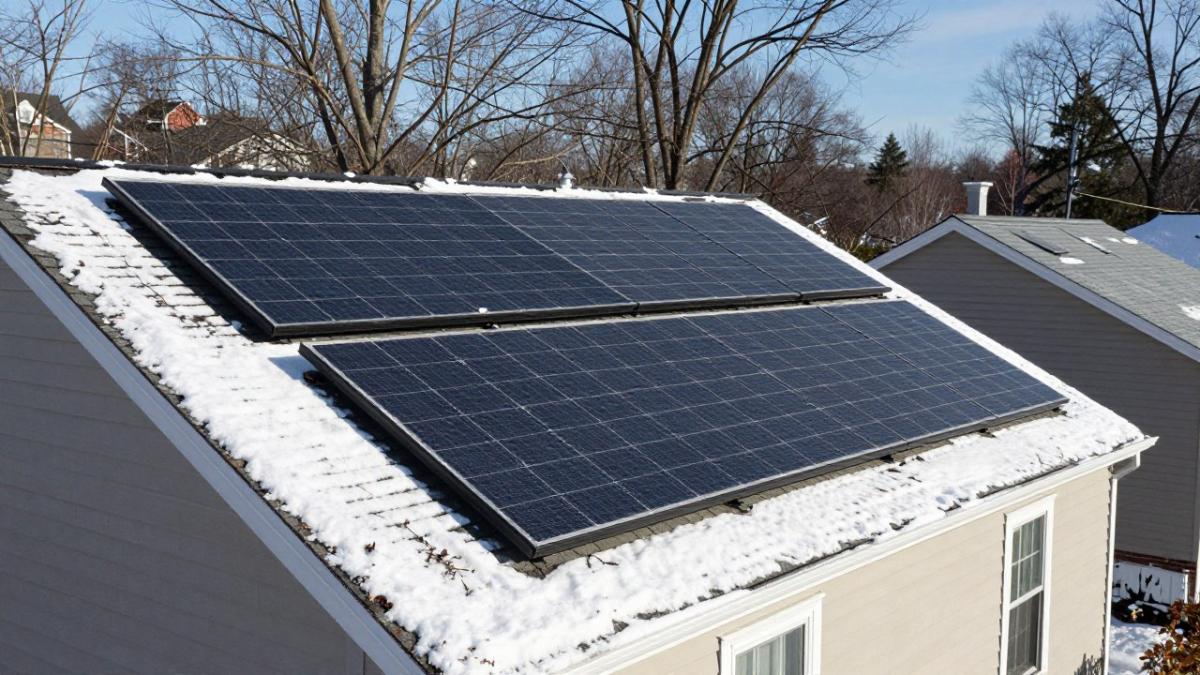
Solar production tracks sun angle and day length, not temperature. Solar production tracks sun angle and day length, so winter months generally contribute less output than summer, and snow cover can reduce output further on the days it sits on the array. Size a system on annual output rather than on a single winter month.
The good news is that annual production is what drives payback. A system that underperforms in January can still hit its yearly target if spring and fall are strong.
Why cold helps and heat hurts
Solar cells generally convert sunlight more efficiently at lower temperatures. The problem is heat trapped under the roof. In-roof shingle systems sit closer to the deck than rack-mounted panels, and the air gap under a panel array provides ventilation that a shingle system does not get for free. That is why roof ventilation, underlayment choice, and installation detailing matter more with shingles than with panels.
Snow shedding, snow guards, and ice dams
Dark, smooth glass surfaces shed snow more readily than textured asphalt, especially on steeper pitches. But shedding is a double-edged sword: snow that releases in a slab can slide onto walkways, gutters, and lower roof planes.
The bigger winter risk is ice damming. When snow melts on the warm upper roof and refreezes at the cold eaves, water backs up under the roofing. A solar shingle roof is only as good as the ice-and-water shield and ventilation beneath it.
What not to do
Do not climb onto the roof to clear snow. You risk falls, damaged shingles, and voided warranties. Most systems are designed to shed on their own within a few sunny days, and production recovers once the surface is clear.
Watch out: a contractor who promises “no winter production loss” is either misinformed or overselling, plan for real winter downtime and judge the system on annual output instead.
Roof Suitability Checklist for New England Homes
Before you commit to solar shingles, confirm that the roof itself is ready. Use this checklist:
- Roof age and condition: a roof near the end of its service life may need replacement first
- Roof pitch and orientation: a south- or west-facing slope with limited shade gives the best output
- Shading from trees and neighboring buildings, checked across the seasons
- Structural soundness of the decking and rafters
- Existing roofing material, such as asphalt shingles or metal roofing, and how the solar product integrates with it
- Local permitting and utility interconnection requirements
- Warranty coverage for both the roof and the solar components
If the roof fails any of these checks, address that first. All Weather Exteriors LLC can assess the roof and recommend repairs or replacement before any solar work begins. Our professional roofing services cover repairs, replacements, and installations.
Booking Your Roof Assessment and Free Estimate
The best next step is a roof assessment that covers condition, suitability, and a written estimate for both roofing and solar options. All Weather Exteriors LLC has served New Hampshire and Massachusetts homeowners for over 25 years, and our team can walk through the trade-offs for your specific home. Request a free estimate and we will review your roof, your energy goals, and the options that fit your budget.
Frequently Asked Questions
What is the average cost of solar shingles for a roof?
Solar shingle pricing depends on roof size, system size, the product chosen, local labor rates, and available incentives, so there is no single figure that fits every home. Because published cost data for this product category is limited and varies widely, we do not quote a typical price here. The most reliable way to compare costs is to get a written, itemized estimate that separates the solar shingles, the roofing underlayment and labor, and any electrical work. Ask each provider for the same scope so the numbers can be compared directly.
Are solar panel shingles worth it in New England?
They can be, mainly for homeowners who want a roof that looks uniform and who are replacing their roof anyway. Conventional on-roof panels are generally the more efficient option, which matters on coastal homes where space and output are limited. Solar shingles install as part of the roof system, which can reduce the visual impact, but that tradeoff usually comes with lower output per square foot. Compare total installed cost and expected production for your specific roof before deciding.
How well do solar shingles work in snow and cold weather?
Cold temperatures generally help solar equipment, but snow cover can block output until it clears. Roof pitch and orientation affect how quickly snow slides off. In-roof systems can run hotter than on-roof systems. Ask any installer for expected winter production and how they handle snow, rather than relying on general claims.