Last Updated: October 23, 2026
Quick Summary
A roofing and siding contractor pricing guide shows that a complete estimate must itemize measured area, materials by brand and grade, labor, direct costs, overhead and contingency, and contractor margin. Published 2026 ranges put a 2,000-square-foot architectural-shingle roof at about $8,900 to $13,100, while siding runs roughly $4 to $18 per square foot installed depending on material.
- Roofing and siding contractors generated $110.6 billion in revenue in 2026 across roughly 144,000 businesses.
- Ridgetop Exteriors estimates $10,200 to $25,500 for a 2,000-square-foot roof replacement in 2026.
- A 1,500-square-foot wall area at $7 per square foot lands near $10,500 installed.
- Ask each bidder for a per-sheet sheathing allowance and a per-linear-foot trim price.
- Never pay the full contract price before the final inspection.
Table of Contents
- What a Roofing and Siding Contractor Estimate Should Include
- Roofing Costs: Materials, Labor, and What Drives the Price
- Siding Replacement Cost: What Homeowners Actually Pay
- How to Compare Roofing Quotes Fairly
- Using a Roofing and Siding Cost Calculator
- Hidden Costs, Permits, and Financing Options
- Conclusion
- Frequently Asked Questions
What a Roofing and Siding Contractor Estimate Should Include
A roofing and siding contractor pricing guide is only useful if it teaches you to read the estimate itself. Roofing and siding contractors generated $110.6 billion in revenue in 2026 across roughly 144,000 businesses, according to IBISWorld data cited by SimplyWise.
A complete estimate should itemize six things: measured roof or wall area, materials by brand and grade, labor, direct costs, overhead and contingency, and the contractor’s margin. Build-Folio’s contractor pricing guide describes a roofing job price as exactly that combination of inputs. If a bid arrives as one lump sum with no line items, you cannot compare it to anything.
Here is the practical test. Ask each contractor to break the number into material and labor, list the underlayment and flashing by name, and state the disposal fee separately. Contractors who know their numbers will do this in an afternoon.
A single lump-sum bid is the most common way homeowners overpay. Without a material and labor split, you cannot tell whether a lower total means a better price or thinner materials.
Roofing Costs: Materials, Labor, and What Drives the Price
Published estimates give you a starting range, not a quote. Roof Cost Data’s 2026 statistics put a 2,000-square-foot architectural-shingle replacement at about $8,900 to $13,100 before local adjustments. Ridgetop Exteriors’ 2026 cost guide estimates $6,200 to $19,000 at 1,500 square feet, $10,200 to $25,500 at 2,000 square feet, and $13,000 to $32,000 at 2,500 square feet.
| Roof Size | Estimated Replacement Range (2026) |
|---|---|
| 1,500 sq ft | $6,200 – $19,000 |
| 2,000 sq ft | $10,200 – $25,500 |
| 2,500 sq ft | $13,000 – $32,000 |
Four factors move you within that range: roof size and dimensions, pitch and slope, design complexity such as valleys and dormers, and the material you choose. Asphalt shingles sit at the low end. Metal roofing, especially standing seam, sits well above them. Flat roof assemblies price on a different scale entirely because the membrane and insulation are separate line items.
Labor is the variable homeowners underestimate. Steep pitch, multiple stories, and old-layer tear-off all add hours, and hours are what you are buying.
Siding Replacement Cost: What Homeowners Actually Pay
Siding replacement cost tracks the same logic as roofing, but the variables are different.
Material choice sets the baseline. The table below shows typical installed ranges per square foot for common siding products, including materials and labor but excluding structural repair.
| Siding Material | Typical Installed Range (per sq ft) | Notes |
|---|---|---|
| Vinyl | $4 – $9 | Lowest material cost; quality varies widely by product line |
| Engineered wood | $6 – $11 | Takes paint well; moisture management matters |
| Fiber cement | $8 – $14 | Heavier; factory-finished lines price at the top |
| Insulated vinyl | $9 – $15 | Adds R-value; thicker profile changes trim details |
| Wood clapboard | $10 – $18 | Highest maintenance; frequent repainting |
A 1,500-square-foot wall area at $7 per square foot lands near $10,500 installed; the same house in fiber cement at $11 per square foot lands near $16,500. That spread is why a single “siding cost” number is meaningless without the product line attached.
Four scope items drive most of the variance between a low bid and a complete one:
- Removal and disposal. Tearing off old siding, hauling it away, and paying dumpster fees is a separate line. A bid that skips removal is not comparable to one that includes it.
- Sheathing inspection and repair. Once the old siding is off, rotted sheathing, house wrap, and flashing become visible. A complete quote states a per-sheet allowance for sheathing replacement rather than leaving it open-ended.
- House wrap and weather barrier. A new weather-resistive barrier is standard on a full replacement; confirm it is listed by product name.
Ask for the siding materials list by manufacturer and product line. A quote that says “vinyl siding” without a product name is not a comparable bid.
Ask each bidder to state a per-sheet sheathing allowance and a per-linear-foot trim price. Those two numbers tell you how the contractor handles the unknowns that show up after tear-off.
On an older home, hidden rot behind the old siding is the single most common source of a mid-project change order. A contractor who prices a sheathing allowance upfront is telling you they have done this before.
How to Compare Roofing Quotes Fairly
Comparing roofing quotes fairly means normalizing them before you look at the bottom line. Two totals are only comparable when they cover the same scope, the same material grades, and the same warranty terms.
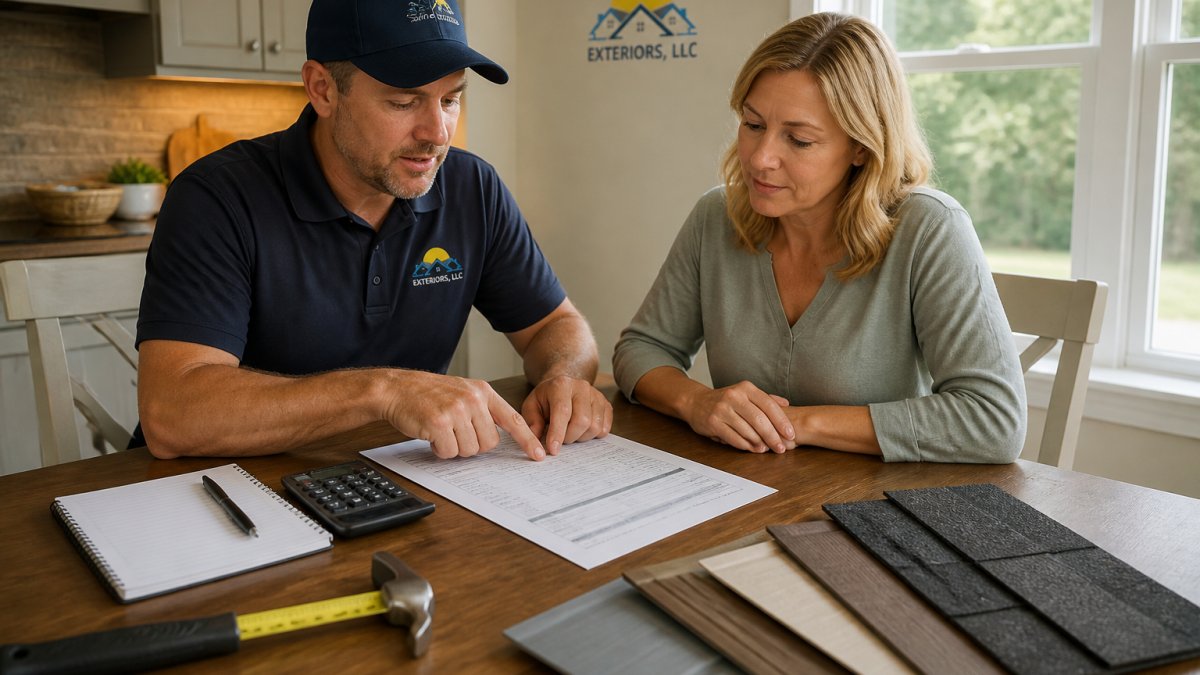
Work through this checklist on every bid you receive:
- Measured area stated in squares, with the roof or wall dimensions shown
- Materials named by manufacturer and product line
- Underlayment, flashing, drip edge, and vents listed separately
When a bid comes in far below the others, the difference is usually one of four things: a thinner material, no tear-off, no permit, or no workmanship warranty. Ask which. A contractor who cannot answer is telling you something.
Send every contractor the same written scope before they quote. When all bidders price the identical scope, the comparison becomes about execution and warranty rather than guesswork.
Using a Roofing and Siding Cost Calculator
A roofing and siding cost calculator is a screening tool, not an answer. It converts square footage and material choice into a ballpark so you know whether a bid is in the right neighborhood.
Use one in three steps. First, enter your rough dimensions and chosen material to get a range. Second, compare that range to the published estimates above. Third, treat any bid outside the range as a prompt for questions, not a reason to sign or walk.
The Federal Trade Commission’s guidance on home improvement contracts is worth reading before you sign anything.
Combined roofing and siding projects deserve their own calculation. Doing both at once usually saves on scaffolding, dumpster rental, and mobilization, because the crew is already on site.
Hidden Costs, Permits, and Financing Options
Most pricing guides stop at the headline range. The number that actually matters is the line-item total, because that is what you sign. This section shows what a complete quote looks like and where the extras hide.
A sample line-item estimate
Below is a realistic structure for a 2,000-square-foot architectural-shingle roof replacement. The dollar figures are illustrative placeholders in the ranges published for that scope, your contractor’s numbers will differ, but the line items are the ones a complete bid should show.
| Line Item | What It Covers | Illustrative Amount |
|---|---|---|
| Tear-off and disposal | Remove old layers, dumpster, haul-away | $1,200 – $2,500 |
| Decking allowance | Per-sheet replacement for damaged sheathing | $300 – $1,500 |
| Underlayment and ice barrier | Synthetic felt, ice-and-water shield at eaves | $600 – $1,200 |
| Flashing and drip edge | Valleys, chimneys, walls, eaves | $400 – $900 |
| Ventilation | Ridge vent, intake vent, boots | $300 – $800 |
| Shingles | Named manufacturer and product line | $3,500 – $7,000 |
| Labor | Installation, cleanup, supervision | $3,000 – $6,500 |
| Permit | Pulled by contractor, fee passed through | $150 – $600 |
| Contingency | 5% – 10% for unknowns | Varies |
Ask every bidder to fill in this structure. When all bids use the same line items, the comparison becomes about execution and warranty rather than guesswork.
Permits and code requirements
Permits are usually required for roof replacement and siding work, and the fee varies by jurisdiction. Two questions settle most of it: who pulls the permit, and what inspections apply. A contractor who asks you to pull it as the homeowner is shifting liability onto you, the permit holder is the party responsible for code compliance. Code upgrades also surface here: some jurisdictions require specific underlayment, ice barrier at the eaves, or ventilation ratios, and those requirements can add line items a low bid omitted.
Financing and payment schedules
Financing and payment schedules matter as much as the total. A reasonable schedule ties payments to completed milestones: a modest deposit, a payment at material delivery, a payment at substantial completion, and a final payment after inspection. Be cautious with any contractor who wants a large deposit before materials are ordered. Many contractors offer third-party financing through home-improvement lenders; compare the annual percentage rate and any origination fee against a home equity line of credit before choosing.
Never pay the full contract price before the final inspection. A payment schedule with a meaningful final payment held back is your only leverage if punch-list items go unfinished.
Insurance claims
If a storm caused the damage, your homeowner policy may cover part of the work. Ask the contractor how they document damage for a claim, photos, measurements, and a written scope the adjuster can price against. Never sign an agreement that assigns your insurance benefits to a third party without legal advice; assignment-of-benefits contracts change who controls the claim.
The hidden costs are not random. They cluster in tear-off, decking, permits, and code upgrades. A bid that itemizes those four is a bid you can actually compare.
Conclusion
The hardest part of this process is not finding a number. It is finding a contractor whose number you can trust, with a written scope, a named material list, and a workmanship warranty you can hold them to.
All Weather Exteriors LLC is a licensed, insured, Master Elite® certified exterior renovation company with more than 25 years of service across the region.
Frequently Asked Questions
What should a roofing and siding contractor’s estimate include?
A complete estimate should list measured roof and siding area, material specifications (brand, grade, and color), labor costs, removal and disposal fees, underlayment or house wrap, flashing and trim, permits, and a clear project timeline. It should also state the warranty terms and payment schedule. Ask for a line-item breakdown so you can compare bids fairly. According to Build-Folio, a roofing job price is built from measured area, materials, labor, direct costs, overhead, contingency, and margin. Missing any of these components can signal an incomplete or unreliable quote.
How much does siding replacement cost, including labor?
Siding replacement cost depends on material choice, square footage, and local labor rates. National industry data shows roofing and siding contractors generated $110.6 billion in revenue in 2026 across about 144,000 businesses, but no single price fits every home. For a 2,000-square-foot home, published roof replacement estimates range from about $8,900 to $13,100 before local adjustments, and siding typically carries similar variability. Request a detailed quote from a licensed contractor that separates material and labor costs so you can see exactly what you are paying for.
How can I compare roofing and siding quotes fairly?
Compare quotes line by line: check that each bid uses the same material grade, includes removal and disposal, covers permits, and specifies labor. Look for exclusions like fascia repair or plywood replacement. A low bid that omits underlayment or flashing is not a fair comparison. Also verify licensing, insurance, and warranty terms. Ask each contractor to explain any differences in scope. The goal is to compare total project cost for identical work, not just the bottom-line number.
What factors make a roof or siding project more expensive?
Steep roof pitch, multiple stories, complex roof design (dormers, valleys, skylights), and difficult access all increase labor time and cost. Material choice matters too: architectural shingles, metal roofing, and premium siding cost more than basic options. Local code requirements and permit fees vary. Hidden issues like rotted decking or insufficient insulation can add unexpected costs once work begins. A thorough contractor estimate should account for these variables and note any potential add-ons.
How do I know if a roofing or siding quote is reasonable?
A reasonable quote reflects local market rates for the specified materials and scope. Get at least three written estimates and compare them side by side. Check that each includes a detailed scope, timeline, and warranty. Be wary of unusually low bids that may cut corners on materials or labor. Verify the contractor is licensed and insured. A quote that is dramatically lower than others may signal missing items or substandard work.
What time of year is the cheapest to replace a roof?
Late fall and winter often bring lower roofing prices in many markets because demand slows. However, cold-weather installation can be risky for certain materials like asphalt shingles, which require warm temperatures to seal properly. In regions with harsh winters, scheduling in early spring or late fall may balance cost and quality. Ask your contractor about seasonal pricing and whether weather conditions affect material performance. A reputable contractor will advise on the best timing for your specific roof type.